
What really changes – and what stays the same – for schools and trusts
The publication of Every Child Achieving and Thriving marks the most significant statement of direction for schools and SEND in England for several years. As with any major white paper, it has prompted both hope and anxiety across the sector.
From our work with schools and multi‑academy trusts, the key question leaders are asking is simple:
What does this actually change for us – and what doesn’t?
Let’s try to cut through the noise.
The message
The white paper is not a sudden reset of accountability, curriculum or governance. But it does reset expectations about what a “successful” school or trust looks like – particularly around inclusion, belonging and engagement, alongside academic standards.
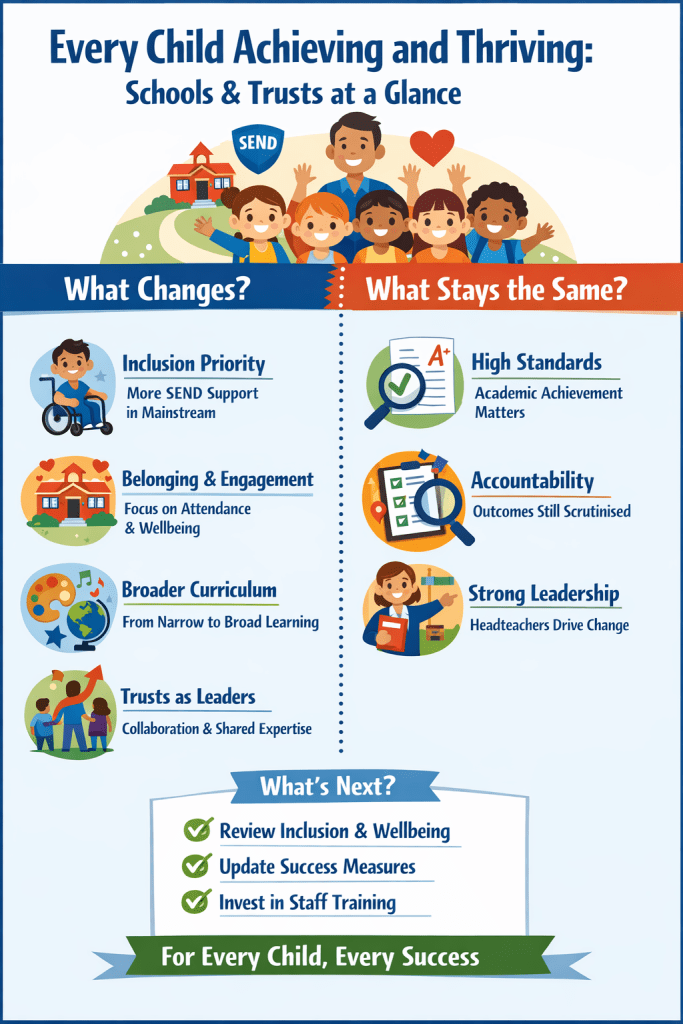
What changes for schools and trusts
Inclusion becomes a core mainstream expectation
Perhaps the clearest shift is the government’s insistence that more children, including those with SEND, should thrive in mainstream schools. The paper explicitly challenges a system where too many children are “sidelined” into specialist provision or disengagement.
What this means in practice
- Schools will be expected to meet a wider range of needs, not just those with EHCPs.
- SEND can no longer sit solely with a SENCo or specialist team; it becomes a whole‑school leadership responsibility.
- Trusts will be expected to ensure consistency of inclusive practice across schools, not pockets of excellence.
This is a cultural shift as much as an operational one.
Belonging and engagement enter the accountability conversation
The white paper places unusual emphasis on pupils’ sense of belonging, engagement and attendance, describing them as prerequisites for achievement. Schools will be expected to monitor and respond to these indicators, not treat them as secondary concerns.
Why this matters
- Attendance, behaviour and wellbeing are no longer “context” – they are core outcomes.
- Trust leaders should expect increased scrutiny of how schools re‑engage pupils who are withdrawn or persistently absent.
This does not replace attainment measures, but it broadens the definition of success.
Curriculum breadth matters more
The government is explicit about moving from “narrow to broad”, arguing that too many pupils experience a restricted curriculum focused on exam performance alone.
Implications
- Curriculum intent, enrichment and wider experiences will carry greater weight.
- Trusts will need to ensure that all schools offer a rich curriculum, not just those serving more advantaged communities.
This reinforces existing inspection signals, but with a stronger moral and policy backing.
Trusts as system leaders, not just operators
The paper repeatedly emphasises schools working together.
For trusts, this means:
- Greater responsibility for supporting schools with higher levels of need
- Stronger expectations around shared expertise, workforce deployment and SEND capacity
- A shift from autonomy‑driven models towards collective accountability
This means that trusts are positioned as vehicles for collaboration, inclusion and improvement across the system.
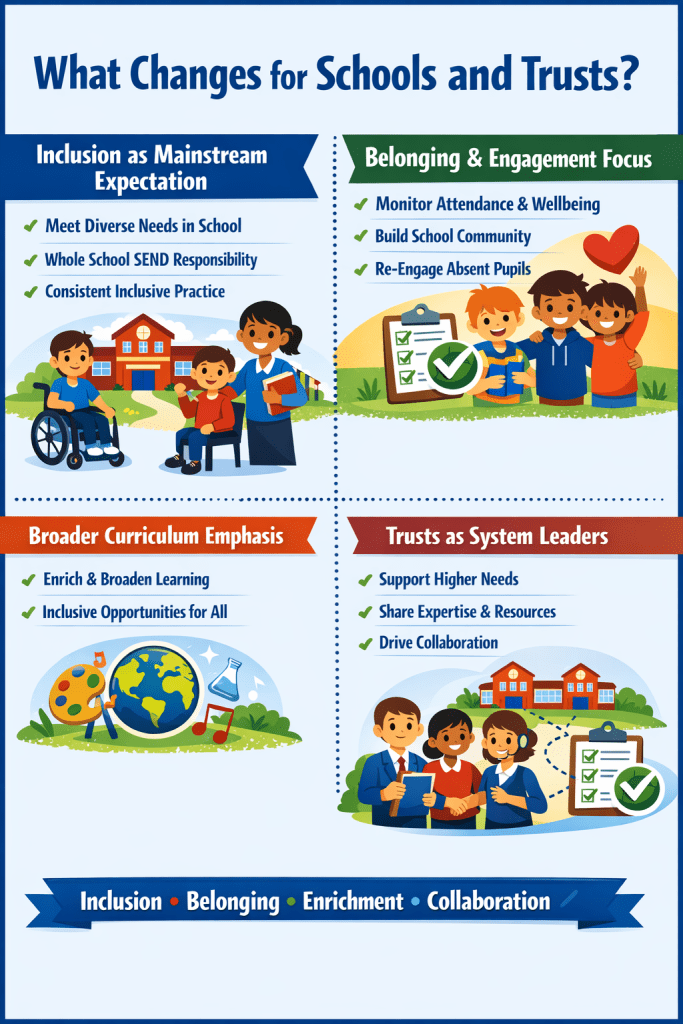
What stays the same (and this matters)
Amid the change narrative, it is important to be clear about what the white paper does not do.
High academic standards remain non‑negotiable
There is no retreat from ambition. The government is explicit that high standards and inclusion must go together, not compete. GCSE outcomes, literacy, numeracy and progression remain central.
The change is not whether attainment matters – but for whom it must improve.
Accountability does not disappear
There is no suggestion of a low‑stakes system. Schools and trusts will still be held to account, but increasingly through a broader lens that includes:
- Disadvantage
- SEND
- Attendance
- Engagement and belonging
Leaders should see this as a reframing, not a relaxation.
School leadership remains pivotal
The white paper does not centralise decision‑making away from schools. Headteachers and trust leaders remain the primary agents of change, responsible for culture, implementation and impact.
What changes is the range of outcomes they are expected to lead on.
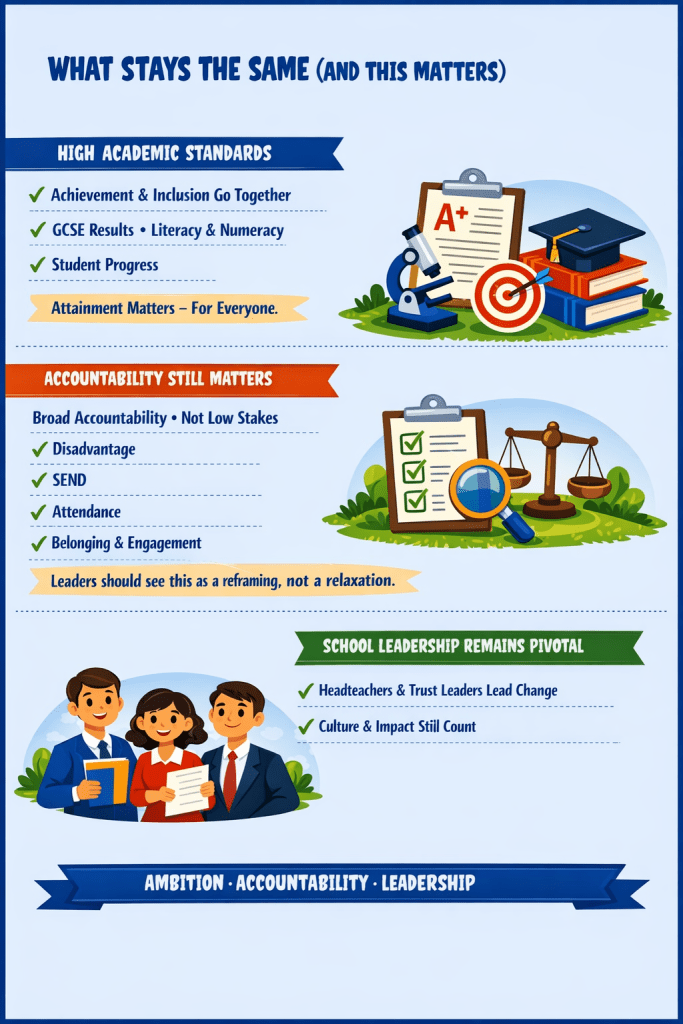
What schools and trusts should do now
While much detail will follow through consultation and guidance, three actions are already clear:
Audit inclusion and belonging
Not policies – lived experience for pupils and families.
Revisit trust‑level definitions of success
Do your dashboards reflect what the system now values?
Invest in workforce capability
Inclusion, SEND and engagement depend on staff confidence and expertise.
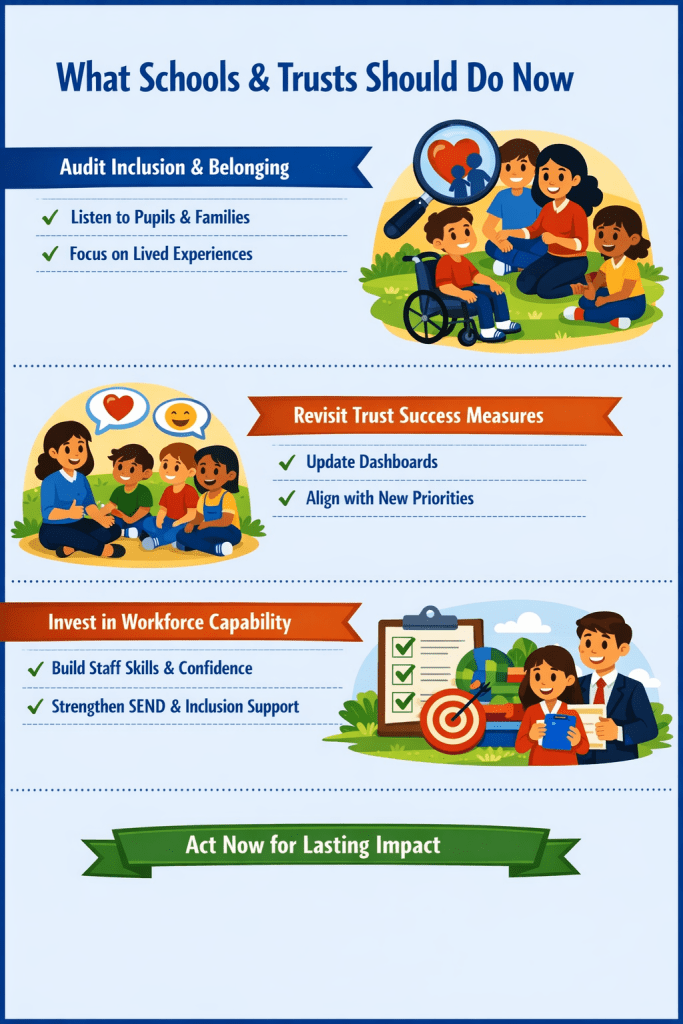
Every Child Achieving and Thriving does not ask schools and trusts to abandon what works. It asks them to extend success to children who have too often been left behind – and to do so without lowering ambition.
For leaders, the challenge is not compliance, but alignment: ensuring that values, structures and measures of success reflect the direction of travel now set out.
This blog was created by Nicki Antwis, Director at Antwis Collaborative.
The Leadership Lens aims to offer a moment of stillness amid the storm—a regular space to consider not only how we lead, but why we lead.
Follow @Antwis Collaborative for updates, and let The Leadership Lens help illuminate your leadership path—one reflection at a time.

 AntwisCollaborative
Leave a comment