
Effective School Self-Evaluation
Recently, while watching Dear England—the television adaptation charting Gareth Southgate’s journey as England manager—we were struck by how many parallels exist between elite sport and educational leadership. As a family of both Scottish and English football supporters, conversations around recent tournaments, qualification campaigns and hopes for the 2026 World Cup are never short of passion or debate. Yet beneath the rivalries and banter lies something both nations have in common: a relentless focus on learning, improvement and preparing for the next challenge.

At its heart, Dear England is not really about football. It is about culture, leadership, reflection, resilience, and learning from failure. Southgate’s transformation of the England team was built upon a willingness to honestly evaluate past disappointments, challenge entrenched beliefs, and create an environment where continuous improvement became everyone’s responsibility.
As England and Scotland prepare for the 2026 FIFA World Cup, both nations will be undertaking rigorous reviews of their recent performances. Coaches, analysts and players will examine what has worked, what has not, and where improvements can be made if they are to compete successfully on the world’s biggest stage.
The same principles underpin effective school self-evaluation.
Great schools do not wait for an external inspection to tell them how they are performing. Instead, they develop a culture of continuous reflection, honest evaluation and purposeful action. Just as Southgate encouraged his players to learn from previous tournaments rather than be defined by them, school leaders must create environments where evidence is used not to judge but to improve.
Effective self-evaluation is therefore not a compliance exercise. It is a leadership tool that helps schools understand their strengths, identify areas for development, and ensure every decision contributes to better outcomes for children and young people.
In many ways, the journey of England’s football team offers a powerful reminder that improvement begins with self-awareness. Before any team can achieve success, it must first understand its current performance. Schools are no different.
Why self-evaluation matters
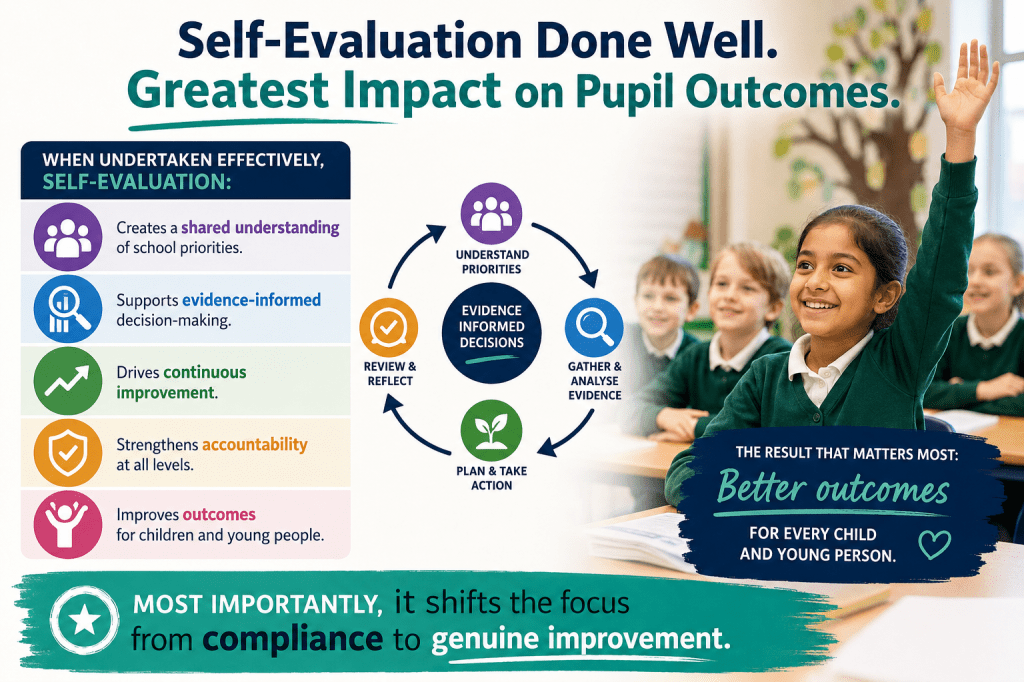
Effective self-evaluation provides school leaders with an honest assessment of what is working well, where challenges exist, and what actions will have the greatest impact on pupil outcomes.
When undertaken effectively, self-evaluation:
- Creates a shared understanding of school priorities.
- Supports evidence-informed decision-making.
- Drives continuous improvement.
- Strengthens accountability at all levels.
- Improves outcomes for children and young people.
Most importantly, it shifts the focus from compliance to genuine improvement.
Performance review
For England, the self-evaluation process is likely to go far beyond simply reviewing results. Reaching the finals of UEFA Euro 2020 & 2024 and the semi-finals and quarter-finals of the two previous World Cup tournaments demonstrates progress, but leaders within the national setup will still be asking challenging questions:

- Have recent tournament performances met expectations, particularly given the depth of talent available?
- Was the balance between defensive solidity and attacking creativity right in key matches?
- Did tactical decisions maximise the strengths of players such as Jude Bellingham, Bukayo Saka and Marcus Rashford?
- How effectively has the transition from experienced leaders such as Harry Maguire and Kyle Walker to the next generation been managed?
- What lessons can be learned from defeats against the very best international teams?
- How can emerging talent continue to be developed to ensure long-term success rather than short-term achievement?
Similarly, Scotland’s qualification for the World Cup represents a significant achievement and an opportunity to evaluate the foundations of that success. Questions may include:

- What factors contributed most to a successful qualification campaign?
- How effectively has the team maximised the strengths of a relatively smaller player pool?
- Which tactical approaches have proven most successful against higher-ranked opposition?
- How can Scotland build greater squad depth to cope with injuries and maintain performance levels?
- What can be learned from recent performances at major tournaments where results have not always matched expectations?
Neither nation will focus solely on outcomes. A World Cup campaign is shaped by leadership, culture, player development, preparation, decision-making and adaptability. In many ways, this mirrors the questions school leaders should ask when evaluating their own organisations. A school’s success cannot be judged solely by examination results, just as a football team’s success cannot be measured only by wins and losses. The real value lies in understanding why outcomes occurred and what actions will lead to further improvement.
Schools should approach self-evaluation in much the same way.
Moving beyond the tick-box exercise
One of the most common pitfalls in school self-evaluation is treating it as an annual event rather than an ongoing process.
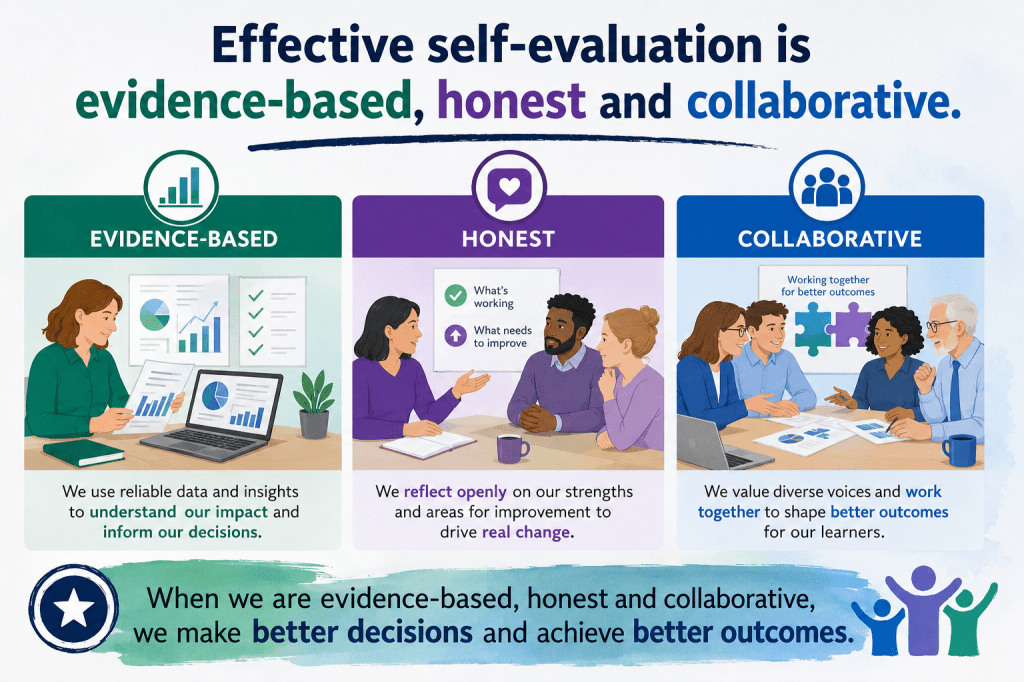
Effective self-evaluation is evidence-based, honest and collaborative.
Evidence-Based
Strong schools triangulate evidence from multiple sources, including: pupil outcomes, attendance data, behaviour records, lesson visits, pupil voice, parent feedback, staff surveys and external reviews. The aim is not to collect more data, but to gather meaningful evidence that supports informed judgements. Southgate’s team used data to identify that English players were spending the least time taking penalties (~2 secs ) compared to the most successful nations (~8 secs) and changed player preparation to finally win a penalty shoot out in a World Cup!
Honest
Football managers know that ignoring weaknesses does not improve performance. The same is true in education. The most effective school leaders create cultures where honest conversations are encouraged. Strengths are celebrated, but challenges are acknowledged openly.
Collaborative
Successful self-evaluation is not the sole responsibility of football managers or senior leaders .
All stakeholders offer valuable perspectives. Engaging stakeholders builds ownership and creates a richer understanding of the school’s effectiveness.
Southgate brought a psychologist into his coaching team to help players deal with the pressure of tournament football.
From evaluation to action
A self-evaluation process only becomes meaningful when it leads to action.
Football teams do not analyse previous tournaments simply to produce reports. They do so to improve future performance.
Similarly, schools should ensure that evaluation findings inform improvement planning, identify clear priorities, allocate resources strategically, establish measurable success criteria and monitor impact regularly. The most effective improvement plans are focused, realistic and rooted in evidence.
The power of the 1%
One of the most powerful lessons from elite sport is the concept of marginal gains—the idea that small improvements, consistently applied, can lead to significant success over time.
This philosophy became famous through British Cycling, where coaches focused on improving dozens of individual aspects of performance by just 1%. On their own, each gain seemed insignificant. Collectively, they transformed results.
The same principle can be seen in international football. As England and Scotland prepare for the World Cup, coaches will not be searching for a single breakthrough that guarantees success. Instead, they will examine hundreds of small details: recovery routines, set-piece effectiveness, communication on the pitch, leadership behaviours, decision-making under pressure, and player development pathways. A one percent improvement across multiple areas can be the difference between exiting a tournament early and reaching the latter stages. The “accumulation of marginal gains!”
Schools can learn a great deal from this approach.
Effective self-evaluation is rarely about identifying one major weakness that needs fixing. More often, it involves recognising numerous small opportunities for improvement and understanding how they combine to enhance pupils’ experiences and outcomes.
For example, improving attendance by a small percentage, increasing the consistency of feedback across classrooms, refining curriculum sequencing in a particular subject improving the quality of questioning during lessons.
Individually, these changes may appear modest. Collectively, they can transform school culture and outcomes.
Importantly, focusing on the 1% helps schools avoid the temptation of chasing the next initiative or quick fix. Instead, leaders can concentrate on sustained, evidence-informed improvement that builds momentum over time.
Just as Gareth Southgate’s England did not become serial tournament contenders overnight, and Scotland’s return to the World Cup has been built over several years of development, school improvement is often the result of hundreds of small decisions made consistently well.
Effective self-evaluation helps leaders identify where those marginal gains can be found. The challenge is not simply asking, “What needs to improve?” but rather, “What is the next 1% improvement that will make the greatest difference for our pupils?”
That mindset creates a culture where improvement becomes continuous, achievable and sustainable—qualities shared by both successful schools and successful teams.
Building a culture of continuous improvement
The strongest schools view self-evaluation as part of everyday practice rather than a document produced for inspection purposes.
Like elite sporting organisations preparing for the World Cup, they continuously ask:
- What are we doing well?
- What can we do better?
- What evidence supports our conclusions?
- What should we do next?
- Who are we telling?
As England and Scotland assess their journeys, celebrate achievements, and prepare for new challenges on football’s greatest stage, school leaders can adopt the same mindset. Success is rarely accidental. It is built on reflection, evidence, honest evaluation, and a commitment to continual improvement.

Final thoughts
At Antwis Collaborative, we believe effective self-evaluation is one of the most powerful drivers of sustainable school improvement. When undertaken thoughtfully and collaboratively, it creates the foundation for strategic planning, stronger leadership, and better outcomes for every learner.
The question is not whether your school should self-evaluate.
The question is whether your self-evaluation is helping you improve.
Because, much like preparing for a World Cup campaign, success begins with understanding where you are today before deciding where you want to go tomorrow.
Come on England!
Come on Scotland!

blog was created by:
Nicki and Simon Antwis
This blog is part of the new blog series from Antwis Collaborative – The Leadership Lens.
If you enjoyed this blog, please take a look at the Antwis Collaborative website. Home (antwiscollaborative.co.uk)
 AntwisCollaborative
Leave a comment