
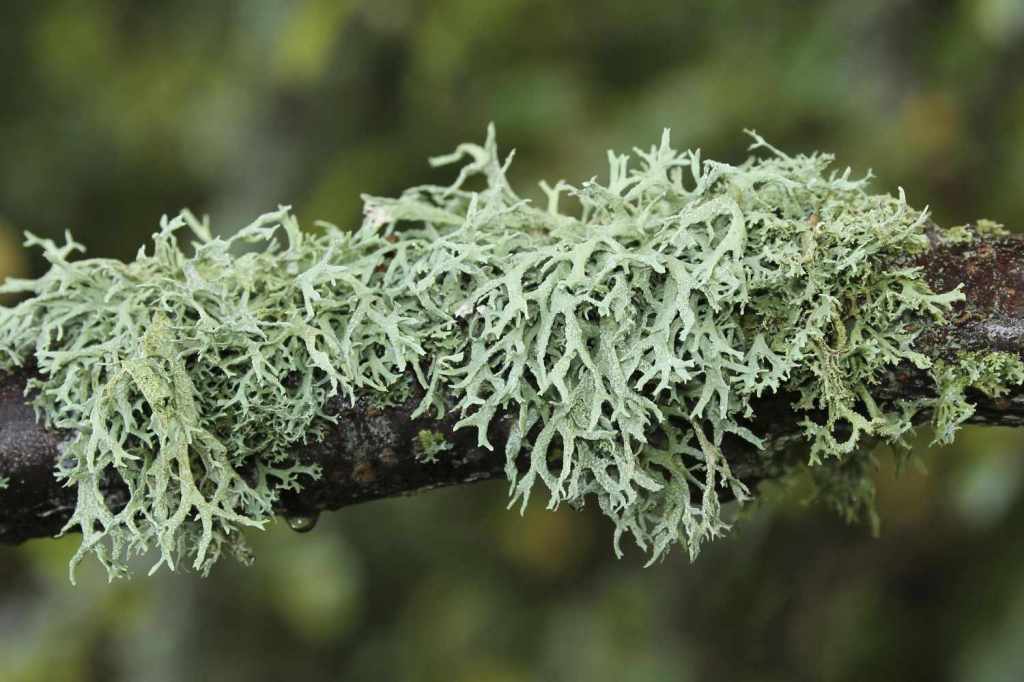
The kids have all left home now. But when they were young, entertaining them usually involved something that was free. Country walks and views usually hit the mark. As a biology teacher I couldn’t help educating them with what was around them. Ask them now what huge bunches of lichens hanging from tree branches tells us and they will groan and shout “unpolluted air, Dad! Now leave us alone!”

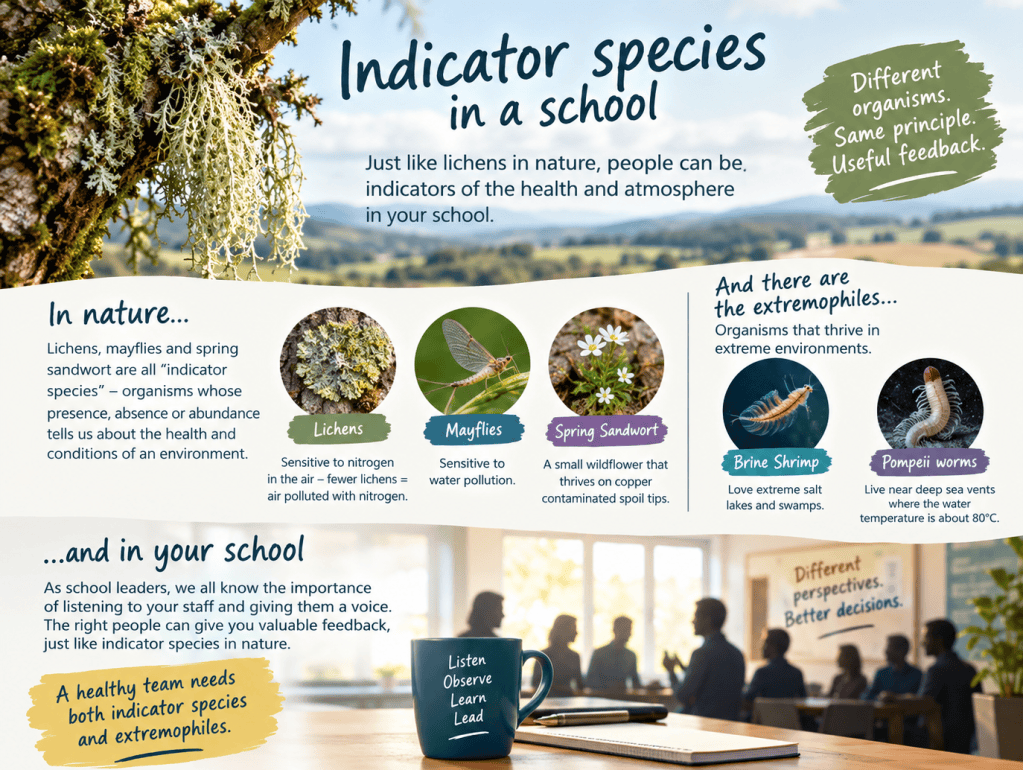
To the uninitiated, lichens are a classic “indicator species.” That means they are an organism that can help scientists indicate the levels, or not, of pollutants in the environment. The actual definition is: “an organism whose presence, absence or abundance tells us about the health and specific conditions of an environment.”
Some common examples are:
- Lichens are sensitive to nitrogen in the air – fewer lichens = air polluted with nitrogen;
- Mayflies are sensitive to water pollution;
- Spring Sandwort is a small wildflower that thrives on copper contaminated spoil tips;
There are also organisms that thrive in extreme environments are therefore called “extremophiles.” Examples are:
- Brine Shrimp (aka ‘sea monkeys’) which love extreme salt lakes and swamps;
- Pompeii worms which love living near deep sea vents where the water temperature is about 80oC.
As school leaders we all know the importance of listening to your staff and giving them a voice. In fact, sometimes just observing their behaviours helped me get a handle on morale and staff wellbeing. I also knew as a Deputy Head the importance of my role in helping the Head to understand the mood of the staffroom particularly after a significant change or crisis.
However, it is probably fair to say that people have different levels of tolerance to change and crisis. It is crucial that you have a handle on who the “indicator species” are in your school. In a population where the unhappiness can sometimes be the default position for some quarters of your staff population it is vital that you can rely on certain members of staff to react in a balanced and measured manner to a controversial decision.
An ideal staffroom or indeed team needs to be a mixture of sensitivities from indicator species at one end of the spectrum to extremophiles at the other. What you don’t want is a team exclusively made of extremophiles who will tolerate unreasonable working conditions offering no feedback. Equally, a team exclusively comprised of indicator species will be oversensitive to every small change. You don’t want a team that agree with everything you say or keep quiet when they are unhappy. A team of exclusively change averse individuals or exclusively change junkies is also not helpful.
I have adapted and changed decisions based on the reaction of certain people in my schools knowing that they are the ideal indicators of the quality and value of a particular decision. It wasn’t uncommon for one of my senior team to report to me that “even Bob (a perfect indicator species) has reacted badly to that decision!”
Have you thought about who are your lichens in the school and who are your brine shrimp? They have huge feedback value to you as a leader.

This blog is part of the blog series from Antwis Collaborative – The Leadership Lens.
If you enjoyed this blog, please take a look at the Antwis Collaborative website. Home (antwiscollaborative.co.uk)

Connect with Us: Let’s explore how Antwis Collaborative can support your leadership and your school. Home (antwiscollaborative.co.uk)


Leave a Reply