
A guest blog from Naomi Moir
Over the last year, I’ve found myself thinking about space a lot. Some of that comes from leaving Oxford University Press after 17 years when my role was made redundant and launching my own business. For the first time in a long time, I had room to think. It made me realise how much leadership is shaped by space: the space to think, the space to contribute and the space to grow.
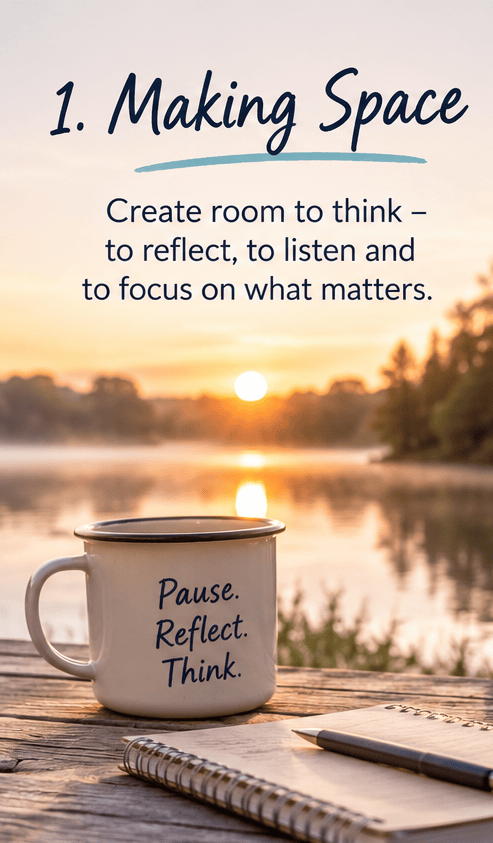
1. Making Space:
We often talk about leadership in terms of action. Making decisions. Driving change. Solving problems. Moving things forward. Yet some of the most effective leadership happens not when we’re doing, but when we make enough space to think clearly about what matters most.
The challenge is that many of us operate in environments where busyness has become a badge of honour and it’s easy to tell ourselves that being busy means we’re being productive, or that being available means we’re leading well.
Without room to think, it’s easy to spend our days reacting rather than responding and focusing on what’s urgent instead of what’s important. That’s why making space has to be intentional.
It means resisting the urge to fill every silence, offer an immediate answer, attend every meeting or solve every problem ourselves. Sometimes leadership requires us to pause before we act. To listen before we speak. To step back before we step forward.
I’ve noticed this repeatedly in my own career. Some of my best thinking has emerged while walking, travelling, talking ideas through with someone else, or simply giving myself permission to slow down – something that I still have to work on doing!
Making space allows us to:
- think strategically
- listen more deeply
- notice what we’re missing
- respond rather than react
Sometimes the most important leadership work isn’t adding something new. It’s creating enough room to notice what already needs our attention.
2. Taking Up Space
Leadership sometimes requires visibility, confidence and the willingness to be seen and while making space often involves stepping back, leadership also asks us to step forward.
For many of us, that can feel surprisingly uncomfortable. Not because we lack ideas or experience, but because taking up space is often associated with being loud, confident or certain. In reality, some of the most important leadership moments happen long before we feel completely ready.
Taking up space might mean:
- sharing an idea that is still forming rather than waiting until it is perfect
- speaking up in a meeting when you have a different perspective
- offering a point of view that challenges the direction of the conversation
- allowing your expertise to be visible, rather than assuming that good work will always speak for itself
- accepting recognition for a contribution instead of immediately redirecting the credit elsewhere.
If I’m honest, this is the area I’ve probably found most challenging over the years. I’ve lost count of the number of times I’ve sat in a room wondering whether I really belonged there, or whether someone else was better qualified to say what I was thinking.
More recently, those questions resurfaced in different ways as I launched my own business. Even now, posting on LinkedIn or sharing an idea publicly can feel surprisingly exposing. The same is true when presenting to senior audiences. There is often a moment beforehand when self-doubt whispers, ‘Who am I to do this?’
I’ve come to realise that confidence usually isn’t something that you have before you act/speak. More often, it develops because of action. We speak, contribute, present, share or lead despite our uncertainty and confidence grows from the experience rather than preceding it.
This matters for everyone, but it’s difficult to ignore the fact that many women have received subtle (and not so subtle!) messages throughout their lives about staying small, not drawing attention to themselves, not appearing too confident or ambitious. Those messages can linger long into our careers, shaping how readily we put ourselves forward or advocate for our own abilities.
Self-doubt isn’t exclusive to women, but understanding the messages we’ve absorbed about who gets to speak, lead and be heard can help us challenge them.
Leadership isn’t about taking the spotlight from others. It’s about being willing to stand in it when the moment requires.

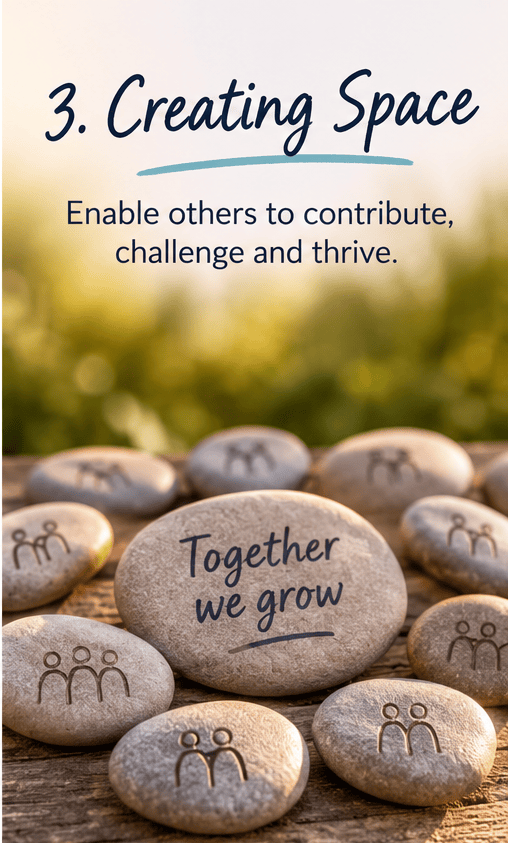
3. Creating Space
If making space is about having room to think, and taking up space is about having the confidence to contribute, then creating space is about enabling others to do the same.
In many ways, I think this is where leadership really comes into its own. Perhaps the real test isn’t how much influence we have ourselves but whether other people have room to grow because of our presence.
Most of us can probably name someone who saw something in us before we fully saw it in ourselves. Someone who invited us into a conversation, encouraged us to lead a project, or recommended us for an opportunity. Often, those moments stay with us not because they changed our job title overnight but because they changed what we believed was possible.
Creating space starts with paying attention. Who’s contributing? Who’s holding back? Whose ideas are being built on and whose are being overlooked? It means creating the kind of environment where people feel comfortable saying ‘I don’t know’, asking a question, disagreeing with an idea or suggesting a different way forward.
Creating space might mean:
- sharing opportunities rather than holding on to them,
- encouraging challenge rather than surrounding ourselves with agreement,
- noticing who isn’t being heard.
Creating space requires curiosity as much as confidence. As leaders, we might ask ourselves:
- Who isn’t speaking?
- Whose voice carries less weight here?
- Who could lead this instead of me?
- What would help people contribute more fully?
I’ve become increasingly convinced that people do their best work when they feel they belong. When they feel seen. When they feel heard. When they know their contribution matters.
Creating space is really about creating that sense of belonging. Helping people feel able to contribute, challenge, take risks, grow and lead.
Importantly, creating space doesn’t mean stepping aside altogether. Leadership still has a role to play in shaping direction, setting expectations, holding accountability and making participation possible rather than controlling every outcome.
Space Is an Ongoing Practice
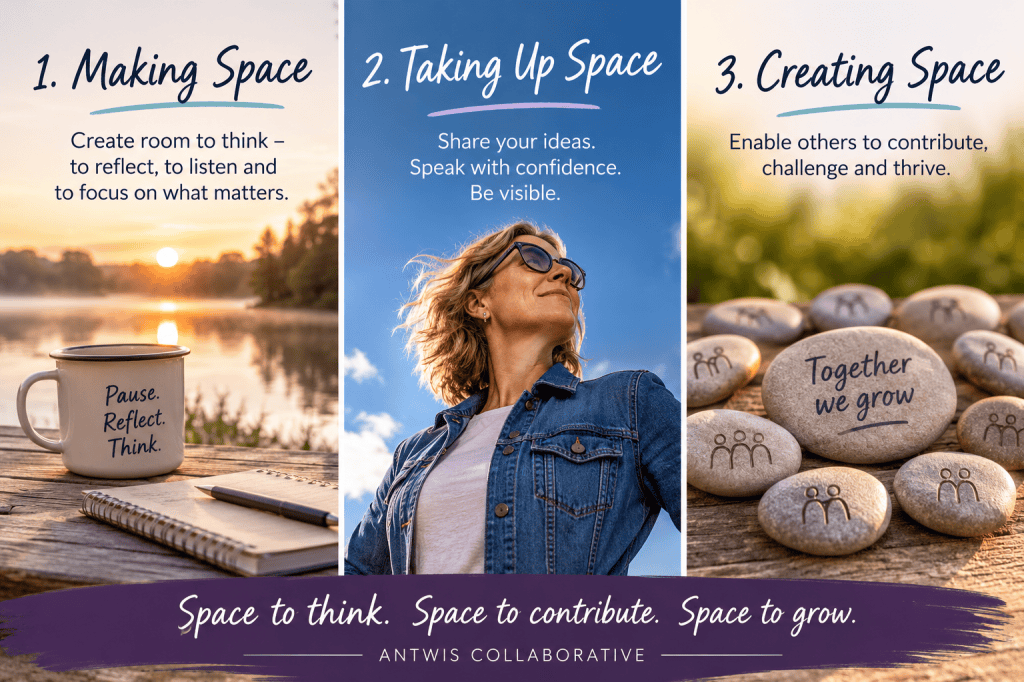
Leadership isn’t always about doing more. Sometimes it’s about noticing where space is needed.
- Space to think.
- Space to contribute.
- Space to grow.
Sometimes that means making space. Sometimes it means taking up space. Sometimes it means creating space for others.
What kind of space do I need right now, and what kind of space might others need from me?
This month’s blog was written by Naomi Moir. Antwis Collaborative met Naomi at the Festival of Education at Wellington College in the summer. What a great connection!
Naomi is a leadership and learning specialist with over 30 years’ experience across schools, education systems and global organisations. After 17 years at Oxford University Press, she now works independently, supporting individuals, teams and organisations to build trust and create the conditions for meaningful connection and effective collaboration. Naomi is known for her practical, human-centred approach to leadership and her ability to bring people together, creating spaces where people feel able to contribute, learn from one another and turn ideas into action.
Website: Home | Naomi Moir
LinkedIn: www.linkedin.com/in/naomimoir


Leave a Reply